
One ledger
Every transaction posts to a double-entry ledger in Postgres, so the totals on screen always add up to something you can inspect.
Open source · Runs on your machine
A double-entry ledger for your own money, with a CFO dashboard on top. Your bank feed goes in; net worth and runway come out. Runs on your machine.
It runs on your own machine against your own database. There's no hosted version and no account on this site — what's here is a demo on sample data and the documentation.
MIT licensed · Your data stays on your machine
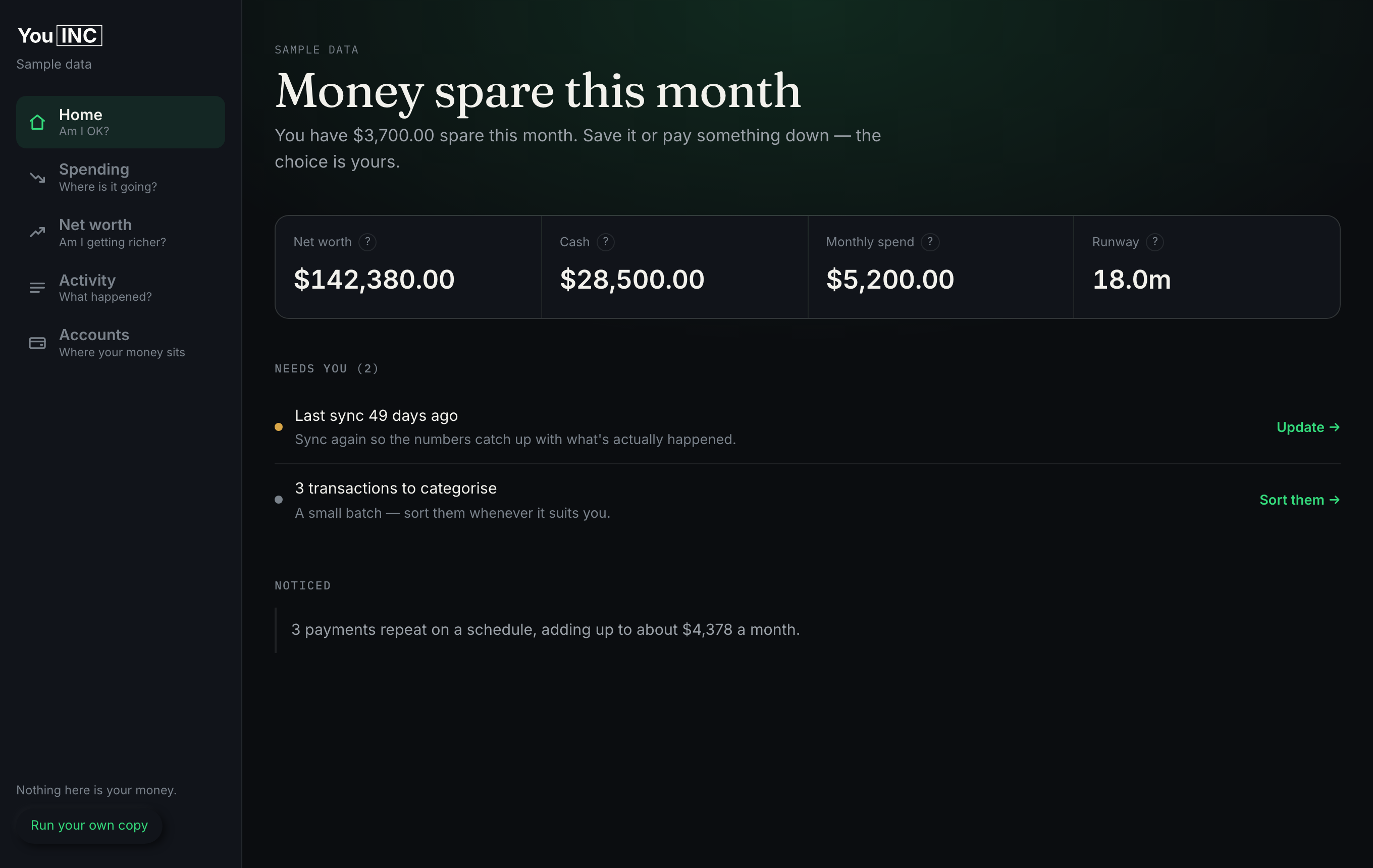
The demo is the application itself, running on a seeded ledger instead of your accounts. Every screen is there and nothing is locked. When you reach the accounts screen it'll tell you how to get your own copy running, because that's the point at which the sample data stops being interesting.
Open the demo →Every transaction posts to a double-entry ledger in Postgres, so the totals on screen always add up to something you can inspect.
New Zealand accounts sync through Akahu using credentials you obtain yourself. Anything a feed can't reach — a house, a car, a private loan — you enter by hand and it sits in the same list.
Transactions are sorted by rules you can read and change. Anything the rules can't place waits in one short list until you categorise it.
The whole history writes out as hledger-compatible plain text, so it stays readable in other tools.
Today that means cloning the repository and bringing up Postgres through Supabase — the steps are in the docs, and it takes a terminal and about ten minutes. Packaging it so you can download one thing and run it is the next piece of work; a container image is the likely first step.
Until then the setup is genuinely a barrier, and it's worth saying so rather than pretending otherwise.